


Harvester Ants of the Ojai Valley, Part 2 : The Red Eye Ordeal and the Mint family Connection
Harvester Ants of the Ojai Valley, Part 2 :
The Red Eye Ordeal and the Mint Family Connection
📌 Missed Part 1 or need a quick refresher?
In Part 1, we explored how California Harvester Ants (Pogonomyrmex californicus) act as “accidental gardeners” by dispersing native seeds, why they carry such a surprisingly toxic sting, and how my accidental backcountry encounter in the mountains behind Ojai revealed an unexpected chemical crossover between ant alarm signals and native mints.
Picking Up the Scent: The Monoterpene Lineage
If you read Part 1, you might recall my surprise at accidentally crushing a Harvester Ant while dealing with a swarm of mosquitoes, only to be struck by the unmistakable scent of European Pennyroyal (Mentha pulegium) and our local native Coyote-Mint (Monardella breweri ssp. lanceolata).
When threatened, Harvester Ants release an alarm pheromone called 4-methyl-3-heptanone. To our human senses, this volatile ketone acts as a structural mimic of pulegone, the potent insect-repelling monoterpene produced by members of the Mint family (Lamiaceae) like the two mentioned above. It is a fascinating example of an animal alarm signal sharing a chemical frequency with plant defenses.
From the Pennyroyal in your herb garden to the Coyote-Mint in our mountains, aromatic plants in the Mint family utilize monoterpenes for defense and communication. But there is a much deeper chapter to this story, one that connects a humble stinging ant to Catnip (Nepeta cataria), the most famous “high” in the garden, and to a profound Indigenous rite of passage.

Coyote-Mint (Monardella breweri ssp. lanceolata). Photo: Lanny Kaufer
The Catnip Connection
While the Harvester Ant’s alarm scent mimics the volatile monoterpenes of wild mints, its sting venom operates on a different frequency entirely: delivering a potent cocktail of enzymes and pain-inducing peptides designed for defense.
Yet the story of ants and mints cuts even deeper into the chemical world. Mints like Catnip (Nepeta cataria) produce a specialized class of monoterpenes known as iridoids (specifically lactones like nepetalactone) to ward off insects and drive felines wild. Remarkably, this entire class of plant defense chemicals was named directly after Iridomyrmex, a genus of ants known for synthesizing these exact same volatile lactones for their own protection.
While our local Harvester Ants rely on ketones for alarm and peptides for pain, they belong to an insect lineage that mastered iridoid chemistry alongside the plant kingdom. Mints and ants independently evolved these parallel molecules over millions of years to signal danger and ward off enemies.
When you crush a leaf of Coyote-Mint on the trail or disturb a nest of Harvester Ants, you are catching a whiff of an ancient evolutionary arms race written in the universal language of organic chemistry.

Mr. Kitty lounging by his favorite Catnip plant (Nepeta cataria)
Mints, Ants, and Indigenous Wisdom
Long before modern laboratories isolated terpenes and ketones, the Indigenous peoples of Southern California observed these relationships through centuries of intimate, empirical observation.
I first learned of the Chumash relationship with Harvester Ants through Healing with Medicinal Plants of the West by healer Cecilia Garcia and Dr. James D. Adams Jr. Notably, the Harvester Ant (Pogonomyrmex) is the only non-plant organism given a full monograph chapter in their entire book, a testament to its immense cultural and medicinal importance in Chumash tradition.
As Garcia and Adams document, Harvester Ants played a profound role in traditional Chumash medicine, ritual healing, and rites of passage. In controlled, sacred settings supervised by members of the ‘Antap society, live ants were rolled into small balls of eagle down and swallowed.
While ethnobotanist Thomas Blackburn once speculated in 1976 that the ant ritual might involve catnip-like iridoids (drawing on a 1969 JAMA article, “Catnip and the Alteration of Consciousness”), Garcia and Adams point to a different pharmacological mechanism altogether. They explain that Harvester Ant venom contains potent polypeptides called kinins. These kinins cause severe pain, systemic inflammation, and a rapid drop in blood pressure, with activities in the brain that may directly induce visions. They also hypothesize another intriguing possibility: that ants consuming seeds infected with Claviceps fungi might concentrate hallucinogenic ergot alkaloids — similar to LSD — in their bodies.
Whatever the precise chemical combination, this was no gentle herbal tea; it was a fierce, carefully guided ordeal (sometimes referred to as the “Red Eye Ordeal”). The intense flood of venom and active compounds induced profound physiological reactions and vivid dreams used to encounter “dream helpers” and seek spiritual guidance.
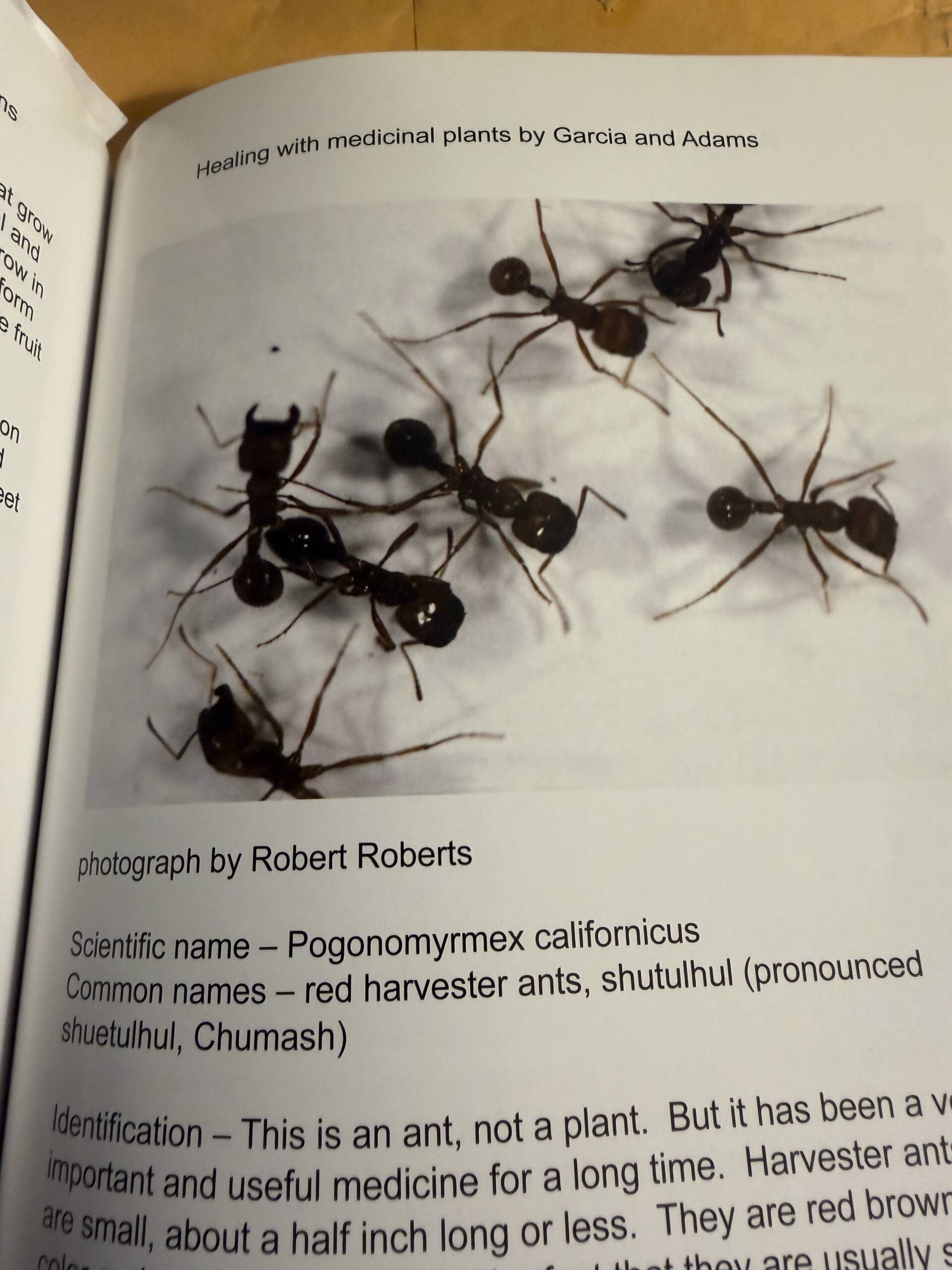
Healing with Medicinal Plants of the West by Cecilia Garcia and James D. Adams, Jr.
Viewing the Anthill with New Eyes: An Archaic Pharmacy
The next time you are hiking a sun-drenched trail in the Ojai Valley and spot a clear, circular disk of bare earth surrounded by tiny pebbles, take a moment to pause (from a safe distance!).
Far from being a mere nuisance, California Harvester Ants remind us that the landscape around us is one giant, interconnected pharmacy:
• Botanical Partners: They harvest, drop, and plant our native wildflowers and shrubs, such as Bush Poppy (Dendromecon rigida).
• Chemical Masters: They share an ancient molecular dialect with our wild mints and catnip.
• Cultural Icons: They carry a rich heritage deeply woven into the history of the human hands that stewarded this land for thousands of years.
In the Ojai backcountry, the line between a garden herb and a stinging insect often disappears into a single, shared molecule. Watch your step around their nests, appreciate their vital work, and keep a fresh leaf of Coyote-Mint or Catnip handy to ward off those pesky mosquitoes!
Coming Soon: The Chemistry, Myth, and Medicine of Catnip
If you’ve ever wondered why a modest herb like Catnip drives felines (including my wife Rondia’s and my 15-pound companion, Mr. Kitty) into a state of blissful euphoria, stay tuned. In Part 3, we’ll dive into the world of Nepeta cataria, explore how a flawed 1960s medical journal article briefly convinced people catnip was a human psychedelic, and uncover the real chemistry of nepetalactone. We’ll look at its proven role as a potent insect repellent, its time-tested medicinal benefits as a gentle nervine and mild sedative for insomnia and anxiety, and how to cultivate it abundantly at home.